
China Food for Thought 4#: July 9, 2024
Dao Foods views China as the world's most important protein and food market from both a climate impact and business opportunity perspective. Our new series China Food for Thought delves into the rapidly evolving alternative protein sector in China, and the broader market trends within the food industry. We selectively curate and share industry news from China with international audiences that may lack easy access to news and trends in China. Our goal is to provide readers with a ground-up view of valuable industry content from the Dao Foods perspective.
1. Oatly Collaborates with Haidilao and KFC on Plant-Based Ice Cream
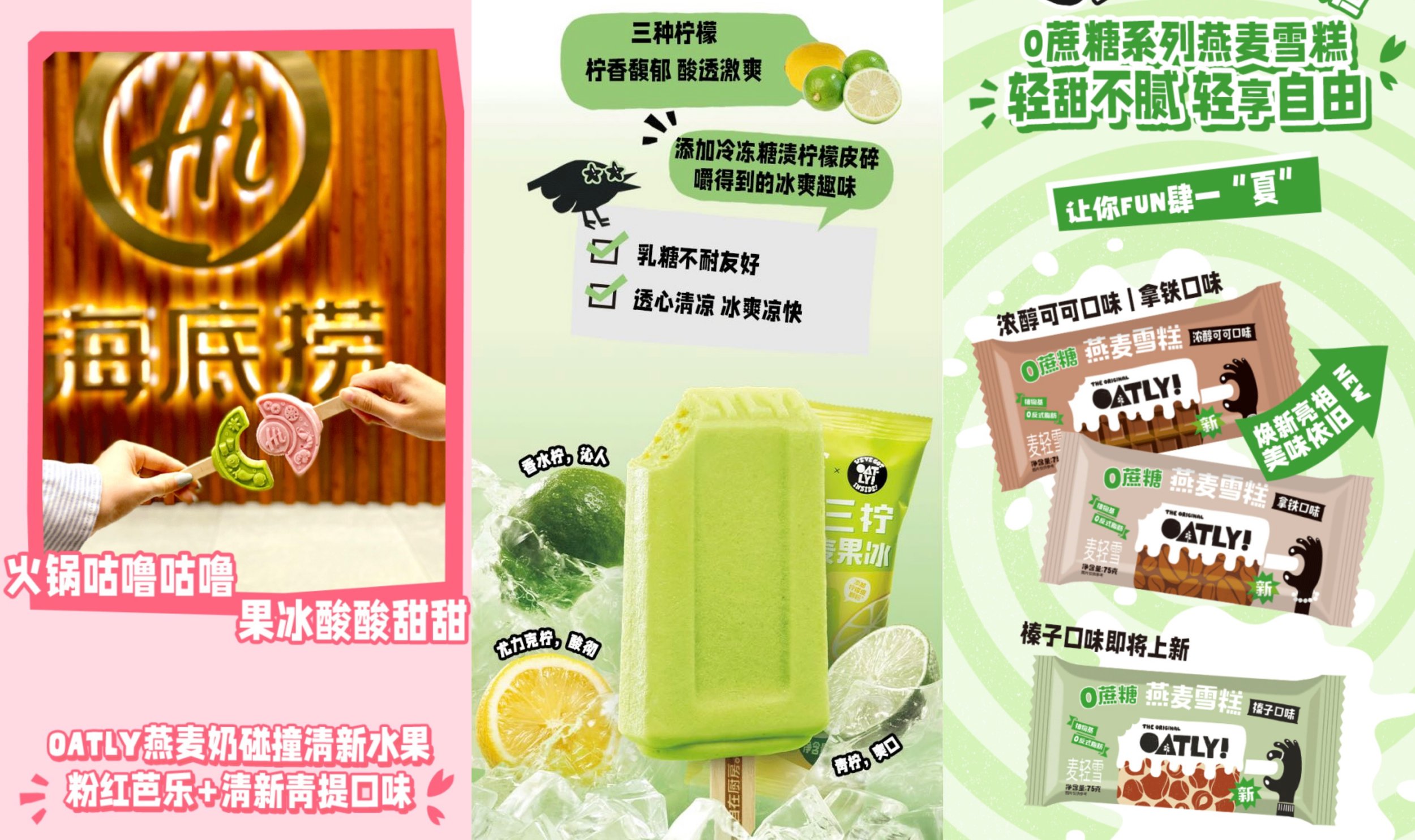
Oatly has partnered with Haidilao to introduce oat-based fruit popsicles. Haidilao is China's largest hot pot chain and one of the top five most valuable food brands globally, only surpassed by Starbucks, McDonald's, and KFC. These treats, designed specifically to complement hot pot, blend oat milk with fresh fruits—offering guava and grape flavors—to provide a sweet and sour counterbalance to the meal's spice while preserving the creamy flavor of oat milk.
Additionally, Oatly has teamed up with KFC for the second time to roll out a limited edition flavor named "Bursting Citrus Trio." This refreshing option features a blend of three lemon flavors, complemented by crunchy, frozen candied lemon peel, providing a cool, zesty treat to consumers.
Since launching oat ice cream in China in 2022, Oatly has not only maintained its classic line but has also collaborated with other brands such as Freshippo and Bilibili to launch new products. This summer, Oatly introduced a zero-sugar version of its oat-based ice cream, catering to those seeking healthier ice cream alternatives.
Resource List:https://www.forbes.com/sites/blakemorgan/2024/05/15/the-5-secrets-of-haidilaos-114b-dollar-customer-experience-success/https://mp.weixin.qq.com/s/v6AUJIXTAPQ7v56Q8hmVngDao Foods Perspectives:
Oatly strategically entered the Chinese market by focusing on the B2B sector, specifically within specialty coffee shops, where it quickly became a staple with its signature oat milk lattes. Between 2018 and 2023, Oatly sold approximately ten billion cups of oat milk lattes in China, with each liter of oat milk yielding four lattes.
Despite its early success, Oatly recently experienced a downturn in revenue in Asia (with China comprising 93% of the Asian market), where it generated $33 million in 2023. This figure represents an 18.9% decrease from the previous year's $40.7 million. In response, Oatly is not only reinforcing its B2B engagements but also actively expanding into e-commerce and retail channels. The company aims to drive growth in the consumer market through innovative products such as oat milk ice cream, aligning with evolving market dynamics and consumer preferences.
Plant-based dairy remains a promising high-growth area, and it seems that innovation in product development, marketing and co-branding is required to achieve traction and success.
2. Lolo Expands Plant-Based Offerings with Quinoa and Oat-Infused Apricot Kernel Milk
Lolo has broadened its product lineup with a new plant-based option that blends Bolivian quinoa and rolled oats from Hebei Province with its signature apricot kernel milk, introduced in June 2024. This mix adds a grainy texture to the smooth apricot kernel milk, positioning it as a nutritious option for breakfast or a healthy snack. Each 220ml bottle delivers 4.4g of protein, is low in sugar, and contains zero cholesterol and zero trans fats.
This year, Lolo also ventured into the bottled coffee market with a new offering that blends apricot kernel milk with coffee, infused with a unique financier flavor. This addition broadens its range of plant-based milk beverages.
Founded in 1975 and listed on the stock market in 1997, Lolo is one of the well-known domestic plant-based milk brands in China. The country has a long history of consuming apricot kernel milk, a tradition that dates back to the Qing Dynasty with desserts like Xing Ren Lao—a custard-like dessert made from apricot kernel milk blended with glutinous rice flour and topped with dried osmanthus flowers.
Lolo's sales trends reflect the recent dynamics of China's plant-based milk market. In 2014, the company sold 333,600 tons of apricot kernel beverages. By 2020, sales had dropped to 182,600 tons. However, with the rising global interest in plant-based milks influencing the Chinese market, sales of apricot kernel milk began to increase again in 2021, leading to three consecutive years of growth. According to its 2023 financial report, sales of apricot kernel beverages surged to 296,500 tons, representing a 13.58% year-over-year increase, marking a strong resurgence, although they have yet to return to peak levels.
Resource List:https://mp.weixin.qq.com/s/47bX4-Xlgky4227UcULY-whttps://mp.weixin.qq.com/s/CfA6UxZIJBLdq8WSlSlE_w?poc_token=HFNgjGajhWF5TcnCWU343rO0-R91Su7cU5_TgTAnDao Foods Perspectives:
As the plant-based milk trend continues to rise, it has notably influenced domestic brands. Lolo has tailored its packaging design and marketing strategies to resonate with younger consumers, capitalizing on this trend. The company's research and development expenditures surged to $4.2 million, representing a significant year-over-year increase of 33.93%—the highest R&D investment since 2017. Lolo has launched several new products besides its classic apricot kernel milk, including variations of almond milk, as well as tea and coffee beverages.
In related news, Austrian biotech firm Kern Tec has successfully secured $12.8 million in a 2023 Series A funding round. In March 2024, Swiss supermarket giant Coop, in collaboration with Kern Tec and Swiss dairy manufacturer Emmi Group, introduced an apricot kernel milk, marking a significant step in diversifying plant-based beverage offerings in European markets.
3. Shanghai Introduces Nutri-Grade Labeling System to Encourage Healthier Beverage Choices
In April, the Shanghai Municipal Center for Disease Control & Prevention piloted a beverage grading system, categorizing drinks into four grades ranging from A to D—A being the healthiest and D the least healthy. This system evaluates beverages based on four key criteria: added sugars, saturated fats, trans fats, and non-sugar sweeteners. The initiative aims to mitigate health risks associated with excessive intake of these components.
Under this new system, a beverage’s overall grade is determined by its lowest component rating. For example, a drink containing 5.6g/100ml of added sugars would receive a C grade; 1.2g/100ml of saturated fats would receive a B; 0g/100ml of trans fats would score an A; and the absence of non-sugar sweeteners would also merit an A. Ultimately, the beverage would be classified as C, the lowest of its individual ratings.
To illustrate how standards are set, consider the threshold between A and B grades for added sugars: it is 0.5 g/100ml, which coincides with the current national standard for pre-packaged foods in China that allows claims of "sugar-free." The threshold between B and C grades for sugar content is 5 g/100ml, matching the national standard for "low sugar."
Early data suggests that the Nutri-Grade labeling system is influencing consumer behavior in Shanghai. Naixue's tea reported a notable increase in sales of A and B grade products; for instance, sales of their newly rated B Master Longjing Tea series surged by about 23% following the implementation. Similarly, Chagee, another participant in the pilot, found that nearly seventy percent of consumers opted for products rated A or B, with the proportion of these higher-grade sales continuing to grow. This trend underscores a growing consumer preference for healthier beverage options under the new Nutri-Grade labeling system.
Resource List:https://mp.weixin.qq.com/s/9aAyWol67CzqascHmcsz_Qhttps://mp.weixin.qq.com/s/Dw_QtBfRBRNjnZ_hrGAp8QDao Foods perspective:
Singapore introduced Nutri-Grade labels for packaged beverages in December 2022, and from the end of 2023, these labels will also be mandatory for freshly made beverages. Since its inception, the initiative has garnered significant attention in China, with many calling for a similar grading system. In the post-COVID era, consumers are increasingly prioritizing "zero sugar," "zero calories," and "zero fat" options, which are becoming compelling selling points across the beverage sector. Furthermore, an increasing number of bubble tea shops in China are promoting healthier versions of their drinks, using real fruit, freshly brewed tea, and avoiding artificial flavors or sugars.
4. Sugar-Free Tea Dominates China's Beverage Market
In 2023, China's sugar-free beverage market reached a size of $3.4 billion, experiencing a remarkable annual growth rate of 110%. According to Nielsen IQ's 2024 Trends and Outlook report, sugar-free tea has now overtaken sugar-free sodas, becoming the largest subcategory within the sugar-free beverage sector.
Nongfu Spring launched the brand "Oriental Leaf" in 2011, with products brewed from real leaves, containing zero sugar and zero additives. The period from 2010 to 2014 was a trial-and-error phase for the sugar-free tea market in China. During this time, major players including Coca-Cola, Nestlé, and Master Kong, alongside numerous domestic and international companies, entered the market. However, this phase largely ended in failure for most brands as mainstream customers at that time preferred sweetened beverages.
In recent years, the preference for tea among young Chinese consumers has become increasingly pronounced. As health consciousness rises and more people monitor their sugar intake, sugar-free tea, in contrast to coffee, appears to be a more suitable daily beverage for the lifestyle of mainstream young consumers in China. In 2023, the "Top Chinese Brands" survey by YiMagazine, demonstrated through online voting, revealed that Oriental Leaf emerged as the top brand in the bottled pure tea category. It took Oriental Leaf 12 years to evolve from being perceived as "hard to drink" to securing first place. The brand's rapid increase in market share commenced in the third quarter of 2022, climbing from 8.4% to 21.1% by the third quarter of 2023.
Today, sugar-free tea occupies a prominent spot in convenience store coolers, attracting a significant number of young consumers who previously did not drink tea. Research by Yiou Intelligence has found that consumers purchase sugar-free tea primarily for its alerting and energizing effects, as well as for hydration and health benefits. Industry insiders predict that these "functional" attributes may allow sugar-free tea to carve out a significant share of the market from bottled water and functional beverages. As the demand for healthy beverages continues to rise among Chinese consumers, DT Finance data from 2023 shows that sugar-free tea accounted for more than 60% of innovations among 41 new tea beverages launched, with 18 brands introducing 25 new sugar-free tea products in 36 different flavors.
Resource List:https://mp.weixin.qq.com/s/E1EuoCUzW7UsIaVWgQuTvAhttps://mp.weixin.qq.com/s/7_RrGJCwfBiyWz-e7bIXrwhttps://mp.weixin.qq.com/s/paFX1OjPDZCYRuw8ihKwkAhttps://mp.weixin.qq.com/s/mC451iFXWOQnvWjAyjO4wwDao Foods perspective:
In 2022, the rate of sugar-free ready-to-drink tea in China was only 7.7%, significantly lower than in South Korea (96.1%), Japan (85.2%), and Malaysia (47.1%). Additionally, the per capita consumption of ready-to-drink tea in Japan is approximately six times that of China. This indicates that there is substantial room for growth in China's ready-to-drink tea market, especially in the sugar-free segment. The market is expected to become more competitive in 2024 as more new tea beverages are introduced.
Dao Foods' portfolio company, PlantNow!, offers sugar-free tea in four flavors and is available nationwide. PlantNow! has also launched a caffeine-free, sugar-free tea available in chamomile, peppermint, and goji flavors.
5. Jiangnan University Achieves Breakthrough in Yeast-Soy Protein Research
On June 10, 2024, Jiangnan University's Science Center for Future Foods announced the online publication of their research, titled "Exploring the mechanism of amylose/amylopectin improving formation of yeast-soy protein high-moisture extrudates based on small and large amplitude oscillatory shear rheology" (Liu et al., Food Hydrocolloids, 2024, 153, 110062).
This study addresses a significant challenge in the field of plant-based proteins: the impact of high proportions of yeast protein (YP), which, despite its high production efficiency and comprehensive nutritional value, can adversely affect the structural integrity of extrudates in meat analog production when it replaces soy protein isolate (SPI). Previous research has indicated difficulties in achieving optimal textural quality when YP accounts for over 50% of the protein content.
The research focused on the addition of different types of starches—amylose and amylopectin—to investigate their effects on the structure of YP-SPI extrudates. Using a closed cavity rheometer to simulate the high-moisture extrusion process, including mixing, melting, cooling, and forming of extrudates, the study found that amylopectin, compared to amylose, significantly improves the fibrous quality and tensile strength of the extrudates.
These findings provide valuable technical insights for developing high-moisture extrudates using YP as a viable alternative to SPI, and contribute to understanding the formation mechanism of fiber structure during high-moisture extrusion.
Resource List:https://futurefoods.jiangnan.edu.cn/zxjj/zxjj.htmhttps://mp.weixin.qq.com/s/BE51NKK-YEJrzsGARCAG9Qhttps://www.sciencedirect.com/science/article/abs/pii/S0268005X24003369Dao Foods perspective:
Established in 2019, Jiangnan University's Science Center for Future Foods occupies 11,000 square meters and is equipped with facilities including a food data lab, a cell-based protein factory, and an artificial food intelligent manufacturing area. The center is further enhanced by advanced technological equipment such as confocal laser microscopes, scanning electron microscopes (SEM), and Nano DSC, which bolster its research capabilities.
The Yeast-Soy Protein study, conducted here, is sponsored by Angel Yeast, China's largest and the world's second-largest yeast producer. The company has recently developed a new yeast protein production line in Yichang, Hubei province, demonstrating its commitment to innovation in sustainable protein sources.
