
China’s Cross-Border Market I: Food Imports in the Age of Tariffs and Transformation
Since April 2025, the U.S. government has imposed a series of reciprocal tariffs on China, escalating its earlier unilateral measures. In response, China issued countermeasures of its own. The tariff rate on Chinese goods rose from an initial 34% to 84%, and later peaked at 145%.
Following a joint statement released during the China-U.S. economic and trade talks in Geneva this May, both sides agreed to deescalate. The U.S. will reduce its tariff rate on Chinese goods from 145% to 30%, while China will cut its rate on U.S. goods from 125% to 10%—a temporary compromise set to last through a 90-day buffer period to facilitate further negotiations.
While tariffs have introduced volatility and uncertainty into bilateral trade, the broader trajectory for China’s cross-border market remains outward-looking. The trend is clear: China will continue expanding economic ties with a broader range of global partners.
For companies and nations alike, retreating into protectionism offers no viable long-term outcome. For Chinese firms in particular, openness does not have to mean a reliance on the U.S. Future growth will come from diversified partnerships across South America, Asia, Europe and certainly Africa whose local needs some Chinese companies have been making efforts to serve in particular .
This article focuses on China’s food imports—covering both food ingredients and consumer packaged goods (CPG) — and how global brands are adapting to the shifting landscape. A separate article exploring China’s food exports will be featured in the next edition.
Soybeans
China’s agricultural imports fell 15.8% year-on-year in the first quarter of 2025 to US$ 44.43 billion, according to customs data. Yet behind the headline decline lies a reconfiguration of sourcing and supply.
Soybeans remain China’s dominant grain import, accounting for 66.7% of total grain volume and 76.4% of value in 2024. But sourcing patterns have shifted dramatically mainly for geopolitical reasons. The U.S. Department of Agriculture reported a collapse in weekly U.S. soybean exports to China in April—from 72,800 tons to just 1,800 tons in one week, a 97% drop.
While U.S. soybean imports have faltered, Brazil has filled the gap. In 2024, China imported 74.65 million tons of Brazilian soybeans (up 6.7% YoY), versus just 22.13 million tons from the U.S. (down 5.7% YoY). As a result, the U.S. share of China’s soybean market fell to 21%, down from 40% in 2016. Brazil’s share rose to 71%.
To secure long-term access, Chinese agribusiness giant COFCO began operating Terminal STS11 in Brazil’s Port of Santos in 2024. Once at full capacity in 2025, it will triple China’s annual grain export throughput from Brazil—from 4.5 million to 14 million tons.
China is also pushing upstream changes. Leading feed companies are reformulating to reduce reliance on soybean meal, while intercropping and local breeding initiatives aim to raise domestic self-sufficiency.
Pork
China is the world’s largest pork consumer—and the biggest buyer of pork by-products, including offal and trotters. In 2024, the country imported 408,000 tons of pork from the U.S., accounting for 17.9% of its total pork imports. But rising tariffs and political factors have reshaped trade dynamics.
U.S. pork exports to China dropped 40.3% year-on-year in 2024. Meanwhile, Spain surged ahead with 541,000 tons, capturing 23.7% market share. The shift reflects a classic substitution effect in global trade: as U.S. pork prices rose by US$0.21/kg due to tariffs, Spanish suppliers—already accounting for 40% of EU pork exports to China—moved quickly to seize the opportunity.
In a symbolic move, Spanish Prime Minister Pedro Sánchez signed a strategic cooperation agreement in Beijing just days after the US-China April tariff hike, with expanded pork exports as a central pillar of the deal.
In recent years, China has seen a steady rise in demand for imported food, driven by two major trends: a general increase in demand and a shift toward more personalized and diversified preferences. Today’s consumers expect more from imported products—flavor, function, story, and alignment with evolving lifestyles.
Chinese consumers are especially drawn to products that are unique, creative, or built around compelling concepts. For instance, Tmall Supermarket, an online e-commerce platform under Alibaba, has spotlighted European chocolates, observing that buyers now assess products by cocoa butter purity, production standards, and the origin of cocoa beans. As a result, Switzerland, Belgium, Italy, and France have emerged as key sourcing regions.
Among imported categories, snacks, chocolates, and alcoholic beverages represent a substantial share of the market. In 2024:
Cocoa and cocoa product imports reached US $1.3 billion, primarily from Malaysia, Indonesia, Italy, Belgium, and Singapore—accounting for over 79% of the total import value.
Alcoholic beverage imports totaled US$4.4 billion, with France leading at US$1.8 billion, followed by Australia, the UK, and Chile.
Another standout is coffee. Once a niche, it is now one of the fastest-growing beverage segments in China—and is even influencing global prices. Bloomberg reported that China has entered the ranks of the world’s top ten coffee-consuming nations, with expectations it may one day become the largest. In 2024, China imported US$1.3 billion worth of coffee, up 18.63% year-on-year, with Brazil, Vietnam, and Colombia serving as the primary suppliers.
Against this backdrop of rising demand and shifting tastes, several brands stand out for how they’ve captured Chinese consumers’ attention—and market share. We profile three imported food brands leading the charge as follows.
IF Coconut Water
On April 9, Thai coconut water brand IF’s parent company, IFBH Limited, filed a prospectus with the Hong Kong Stock Exchange, aiming to raise over US$128 million. In 2024, the company posted US$158 million in revenue—92.4% of which came from mainland China, where it commands an estimated 34% share of the coconut water market.
IF coconut water
IF first entered the Chinese market in 2017, at a time when the beverage space was already saturated with choices. Coconut water, however, was still a niche subcategory with low consumer awareness and limited demand.
That changed after 2020. The pandemic accelerated demand for natural hydration and electrolyte-rich drinks, IF’s minimalist packaging, “100% juice” positioning, and clean ingredient list made it a natural fit for this new health-driven lifestyle.
But the turning point came from Luckin Coffee. Its viral coconut latte became a breakout hit, since when coconut has exploded in China’s beverage market. Today, nearly every major coffee and tea chain in China offers some form of coconut-based drink, and IF rode that wave with precision timing.
IF operates with an ultra-light asset model. Its parent company, IFBH Limited, employs just 46 people globally, focusing on product development, marketing strategy, and contract manufacturing oversight. All production, logistics, and supply chain functions are outsourced. For example, In China, IF runs a dual-distribution system:
A leading e-commerce partner manages online channels like Tmall, JD.com, and Douyin(Chinese TikTok)
A separate trading company handles offline retail, covering supermarkets and convenience stores
IF’s rise was also about tactical marketing. Between 2022 and 2024, its marketing expenditures skyrocketed from US$1.8 million to US$7.53 million. In 2022, at the height of China’s livestream e-commerce boom, IF harnessed the power of major influencers to drive a 300% quarter-over-quarter sales surge.
If x Pop Mart
As livestreaming began to cool, IF quickly pivoted—becoming a collaboration powerhouse. It launched co-branded campaigns with popular local IPs such as Pop Mart and Luckin Coffee, tapping into youth culture and collectible trends. In 2023 and 2024, celebrity endorsements from Lusi Zhao and Zhan xiao, well-known Chinese actress and actor respectively, propelled the brand to new heights of visibility and consumer affinity.
IF’s marketing spend in 2024 is US$7.36 million, with promotional costs rising from 4.2% to 4.7% of revenue—a sign of the company’s continued investment in brand equity.
In contrast, Vita Coco, the world’s largest coconut water brand entering China in 2015 and boasting a global celebrity-studded endorsement lineup—including Rihanna, Madonna, and Demi Moore—failed to adapt to local market dynamics.
By focusing on high-end gyms and grocery stores and pricing its products at around ¥15 (~US$2) per bottle, Vita Coco positioned itself in a niche that proved too narrow. In contrast, IF’s ¥5–6 (~US$0.69–0.83) price point and mass-market strategy made coconut water accessible to a much broader consumer base.
Today, IF outsells Vita Coco seven to one in China—a decisive victory for local insight over global brand cachet.
OATSIDE
OATSIDE, one of Singapore’s most prominent oat milk startups, was founded by Benedict Lim, former CFO of Kraft Heinz Indonesia. Since launching its first product in 2021, the brand has expanded to over 20 countries and regions in just over two years.
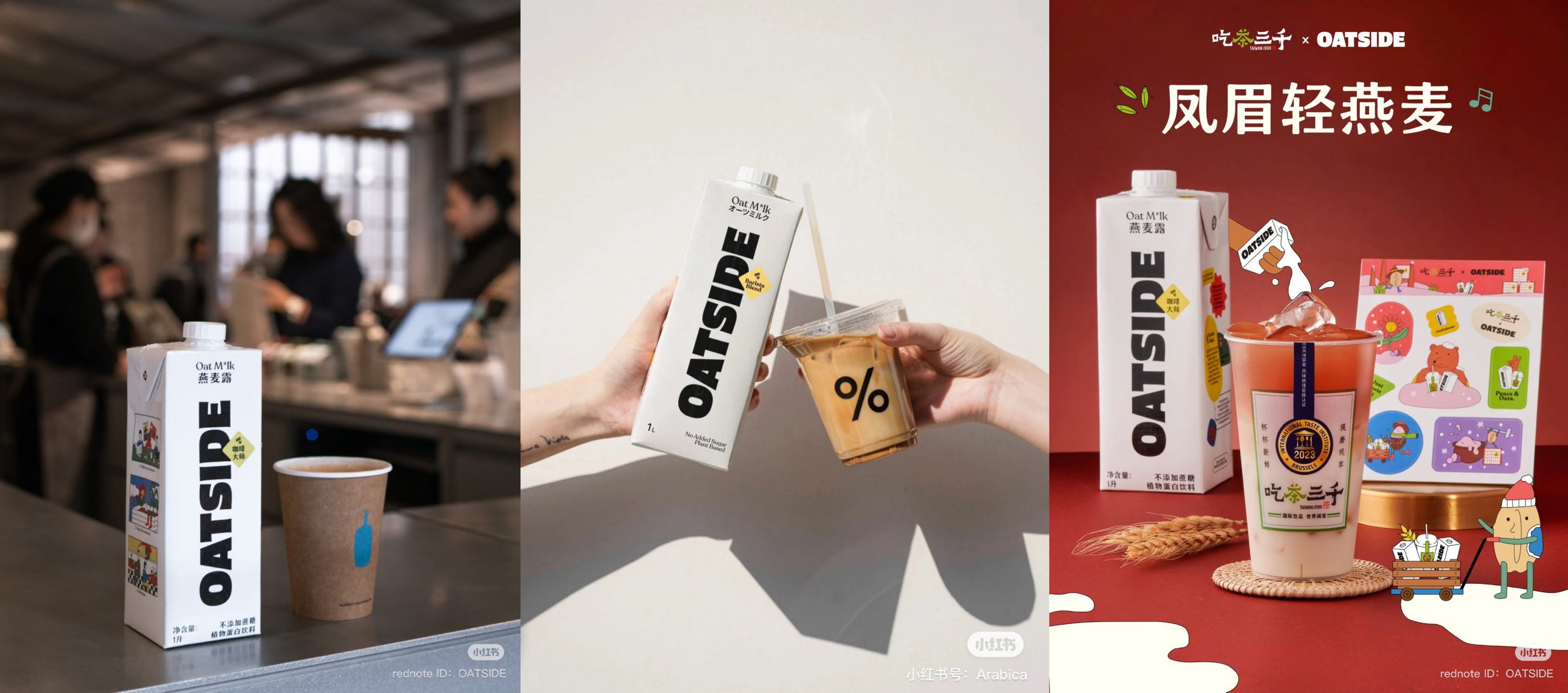
From left to right: Oatside’s collabration with Blue Bottle, %Arabica, and CHICHA San Chen
In 2023, OATSIDE entered the Chinese market with a premium positioning strategy—partnering with coffee chains such as %ARABICA and Blue Bottle Coffee to build early brand recognition. The goal: to win over China’s growing base of coffee enthusiasts and introduce oat milk not just as a dairy alternative, but as a flavorful beverage in its own right.
Lim believes the first sip is everything. Many oat milks on the market are overly heavy, oily, or astringent—particularly unsuited for Asian taste preferences. OATSIDE was developed specifically for direct consumption, offering a smoother, cleaner flavor profile that resonates with local consumers.
The brand’s mission extends beyond plant-based loyalists. Rather than preaching sustainability, OATSIDE focuses on winning over mainstream drinkers through taste—inviting them to adopt more sustainable habits, one enjoyable experience at a time.
Oatside x Crying Centre (a Chinese fashion brand), Oatside products, and Oatside x CASETiFY
Beyond its café presence, OATSIDE has launched three ready-to-drink (RTD) oat milk SKUs available through major local e-commerce platforms including Tmall, JD.com, and Douyin(Chinese TikTok). Offline, the brand has gained shelf space in Ole! supermarkets(au upscale grocery chain with 120 stores nationwide), FamilyMart, and U-home convenience stores (with 1,000 locations across cities in South China).
In 2023, OATSIDE secured a US$35 million funding round, the largest AgriFoodTech deal in Asia-Pacific’s innovative food category that year. It’s not just a vote of confidence in plant-based beverages—but in OATSIDE’s ability to reshape how oat milk is experienced and enjoyed across the region.
Almond Glico
While many emerging brands are shaking up China’s plant-based space, legacy players are also evolving to stay competitive. One standout is Glico, a Japanese food giant founded in 1922. With over a century of history, Glico has long been a household name in China. Since entering the market in 1995, the company has introduced beloved snack brands such as Pocky, PRETZ, and Bisco, securing a strong position in the country’s competitive snack sector.
Almond Glico
In 2021, Glico capitalized on the growing demand for plant-based milk by launching its almond milk line in China. Within just a few years, it rose to the #1 spot in national almond milk sales, marking a new chapter of growth for the legacy brand.
This success is no coincidence. Glico’s expansion in China is rooted in a deeply localized strategy aligned with shifting consumer behaviors. From addressing basic nutrition in the 1990s, to supporting healthy eating in the 2000s, and now connecting food with identity and self-expression, Glico’s R&D efforts have consistently mirrored China’s evolving food culture.
The brand has also embraced innovative retail and marketing tactics. It was the first international food group to integrate both brand-building and performance marketing on RedNote, an Instagram kind of social media platform in China, and one of the earliest to adopt the platform’s closed-loop conversion model—where consumers, after being influenced by content, can purchase products directly within the platform.
By co-creating content with RedNote influencers and conducting rapid-fire testing and optimization, Glico was able to amplify high-performing campaigns through precision-targeted ads and search. This approach helped the brand expand beyond its traditional base and connect with younger, health-conscious consumers.
From left to right: Glico’s collaborations with Sanrio, Harry Potter, and Crayon Shin-chan
The results were compelling. In just four months, Glico’s almond milk content penetration on RedNote grew from 1% to 20% in the plant-based beverage category, making it the #1 brand by share of voice. Its audience expanded by 5 million, propelling it from outside the top 30 to a Top 5 position in the category.
As tariffs and supply chains continue to evolve, one thing remains clear: China’s food market is open—but the rules for success are shifting.
The rise of IF, OATSIDE, and Glico highlights a broader trend: brands that localize both taste and marketing are best positioned to win. Flavor profiles that resonate with local palates, combined with culturally attuned branding and channel strategies, are proving far more effective than one-size-fits-all global approaches.
Gold Roast — Viz Branz’s Flagship Brand in China
Singapore–China synergies will likely grow. Viz Branz, as an example, headquartered in Singapore and focused on Southeast Asia and China, now generates over 60% of its revenue from the Chinese market. In 2025, Viz Branz designated Guangzhou, Guangdong Province, as its R&D Center, aiming to leverage talent resources from Hong Kong and overseas to enhance its ability to innovate.
A recent example is the launch of the new Fibro brand. Developed in Guangzhou and launched in Singapore, the product leverages Singapore’s strategic geographic and political position to quickly penetrate the broader Southeast Asian market. From there, the products are reintroduced into China in a cross-border circulation model. Coupled with targeted marketing through platforms like RedNote, this circular approach has enabled Viz Branz to build a more agile and globally integrated strategy.
Keenly aware of this cross-border trend, Dao Foods will continue to work closely with stakeholders from Singapore such as Enterprise Singapore in 2025 to support more forward-thinking brands in entering the Chinese market from or via Singapore.
In conclusion, while the trade environment remains volatile, it also creates space for innovation. Companies that can navigate shifting policies, respond to local demand, and deliver differentiated products are well-positioned to thrive. Beyond the U.S. market, high-growth opportunities abound in Asia, Latin America, and Europe—markets that are becoming just as critical to the global strategy of any internationally ambitious food company.
No matter where the trade war goes next, China, without a doubt, will remain a key destination for global food innovation. Well prepared and positioned, Dao Foods certainly will continue to champion sustainable, high-impact brands ready to seize the opportunity.
Resource List:https://www.jpmorgan.com/insights/global-research/current-events/us-tariffshttps://www.cnn.com/2025/04/13/business/american-farmer-china-trade-trump-intl-hnk-dghttps://www.bloomberg.com/news/articles/2025-04-08/key-brazil-port-bustles-as-china-poised-to-shift-away-from-ushttps://www.reuters.com/markets/commodities/china-expands-access-spanish-pork-trade-tensions-with-us-mount-2025-04-11/https://www.sohu.com/a/678743104_120536144https://paper.people.com.cn/rmrbhwb/html/2023-11/30/content_26029471.htmhttps://mp.weixin.qq.com/s/eQTjrUJn-3nd2u_gmWFTjAhttps://mp.weixin.qq.com/s/DLK8yvKqUILhJBLBacH6uwhttps://mp.weixin.qq.com/s/vpTjspc7AGVulb40nveVewhttps://mp.weixin.qq.com/s/EyAaJbaRFsGOh9E-ug5puwhttps://www.xiaoyuzhoufm.com/episode/66da2a0379de2cd416c76877https://mp.weixin.qq.com/s/aQwqFB6CbndBMfLWnZxVXghttps://mp.weixin.qq.com/s/14K-gnqHjn3id_wYeDkZiwhttps://mp.weixin.qq.com/s/1blLzbVChJRZ0im86Tj0sQ