
China’s Cross-Border Market II: Lessons for Sustainable Food Brands from China’s Export Wave
In our last issue, we discussed the environment and opportunities for international companies looking to export products into China. In this issue, we look at how Chinese companies are looking at international markets and what opportunities there might be for partnerships. To do that, we review some examples of companies that are having some success, both in the food sector and beyond.
China is no longer just the world’s factory. A new wave of companies is going global with brand-driven strategies.
For the past two decades, “Made in China” has meant scale, speed, and low cost. China fueled global supply chains in industries like clothing, furniture, and home appliances. Although China provided goods to the world, few of its own brands were well-known worldwide.
That is now changing. A new wave of Chinese companies is going global — not as OEMs, but as consumer brands with their own identity and storytelling. Instead of competing solely on cost, they’re winning on innovation, design, and cultural relevance.
Electric cars, lithium batteries, and solar panels are the three new categories in China where the trend is most noticeable, but it is also extending to products like gaming and cosmetics. China is no longer just the world’s factory. It’s starting to export brands.
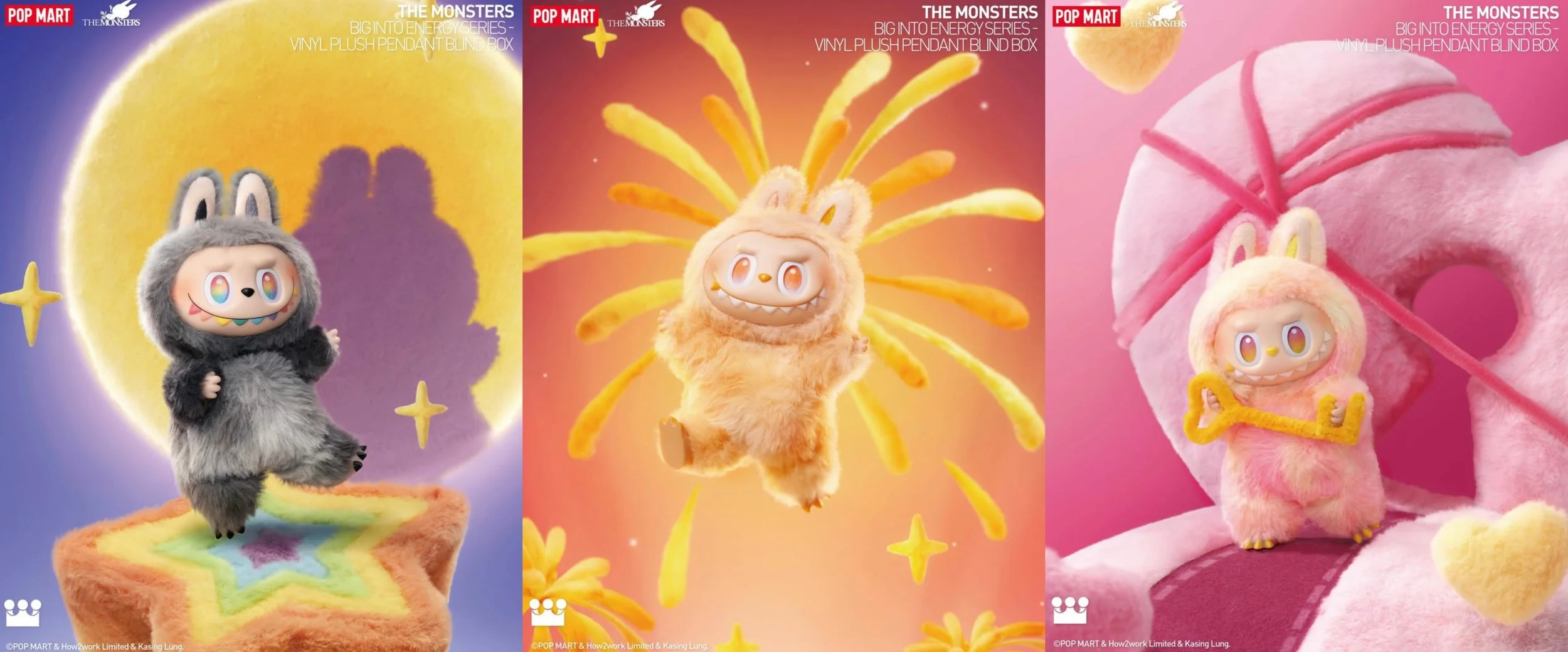
THE MONSTERS - Big into Energy Series
One of the most surprising examples of this shift is Labubu — a mischievous toy from Pop Mart’s Monster Series. Labubu has gone global: from Bangkok to London, fans queue outside Pop Mart stores, while celebrities like Blackpink’s Lisa and Rihanna post their collections online. What started as a niche IP is now a global craze. Pop Mart's rapid production, product iteration, and worldwide retail rollout helped Labubu succeed by tapping into emotional identity and cultural storytelling.
While Pop Mart is a toy brand, it offers a broader lesson: Chinese consumer brands — including food and beverage — can find success abroad by understanding what global consumers value and building their brand around it.
More on Labubu later…
Slowing domestic demand, policy support, and trade pressures are pushing Chinese companies overseas.
The Tariffs Trigger
The tariff battles initiated during the Trump administration—marked by four rounds of levies on Chinese goods since 2018—have fundamentally altered the global supply chain calculus for Chinese firms. This has forced many Chinese companies into a “wanderer factoryˮ mode—relocating manufacturing from one country to another to stay ahead of shifting tariff walls.
The result is a faster and broader internationalization of Chinese industry. Initially reactive and passive, firms are now moving aggressively to pre-empt risk and build long-term global positions.
Internal Drivers: Overcapacity, Slowing Demand, and National Policy
China’s global expansion is not solely a reaction to external pressures — it is increasingly driven by internal structural shifts. Chinese businesses are being urged to seek growth abroad in response to growing industrial overcapacity and a slowdown in domestic consumption.
Policy support has played a key role in this shift. Introduced in 2015, the Made in China 2025 strategy laid out a ten-year plan to transform the nation from a base of labor-intensive manufacturing into a high-tech industrial powerhouse. By promoting digitalization and intelligent manufacturing, the policy laid the groundwork for long-term global competitiveness.
As Chinese firms move up the value chain and build technological capabilities, going global is no longer just about offloading surplus production. It has become a strategic pursuit of higher margins, brand value, and market resilience in international markets.
This new wave “going global (chu hai)" is qualitatively different from traditional contract manufacturing or export models. It's not about using supply chains based in China to fulfill orders from overseas. Itʼs about building factories abroad and integrating operations in local economies.
CATL’s battery factory in Hungary (Hungary Today)
Chinese companies are also strategically seeking supply chain proximity and resource alignment. For example, Contemporary Amperex Technology (CATL) alone is investing over US $8.2 billion in a battery plant in Hungary. The logic is clear: locating production near major European carmakers enables faster market entry and logistical efficiency. China is now Hungary's largest automotive investor, surpassing South Korea and Germany in just two years in EV-related investments.
But in the process, something deeper is happening. Chinese enterprises are maturing into multinational corporations, The global business order is being reshaped—and China is not just reacting to that change, but actively driving it.
Restaurant chains like Haidilao and Mixue are leading the way, starting in Southeast Asia
In recent years, Chinese government agencies have actively supported the international expansion of domestic restaurant brands. In September 2024, the Ministry of Commerce released the Guiding Opinions on Promoting the High-Quality Development of the Catering Industry, which explicitly called for accelerating the “going global” of Chinese cuisine and encouraging restaurant operators to expand into overseas markets.
The year 2023 was widely hailed as the “first year of Chinese cuisine going global.” Southeast Asia has become the primary location for this expansion, with Singapore emerging as a strategic launchpad. The city-state is a natural choice, given its affluent, ethnically Chinese-majority population and its status as a regional business hub. In 2024 alone, 32 Chinese restaurant brands opened 184 stores in Singapore—an impressive sign of momentum.
Among the pioneers of this wave are hotpot powerhouse Haidilao and bubble tea chain Mixue. Let’s take a closer look at how these two brands are charting their overseas journeys.
1) Haidilao:Building Repeatable Global Infrastructure
Haidilao
Haidilao has emerged as one of China’s most globally recognized food-service brands, demonstrating how service-led experiences can scale internationally with localized infrastructure and operational discipline.
As of year-end 2024, the company operated more than 1,400 stores worldwide. It posted US $5.95 billion in domestic revenue, up 3.1% YoY, with net profit rising 4.6% to US $654.24 million.
And just like that, S3E12: Carrie eats at Haidilao’s NYC store
In 2012, the hotpot behemoth opened its first store abroad in Singapore. With a population of only six million, it currently runs 20 stores in the city-state and 122 locations in 14 other countries. With notable mentions in pop culture — Woody Allen and Jessica Alba have been photographed dining in its restaurants, while And Just Like That… featured Carrie Bradshaw eating solo at a New York branch.
Haidilao’s international supply chain evolved in three stages. Using Singapore as an example: initially, it partnered with top local suppliers to avoid early capital-heavy investments. As its presence grew, it established a regional central kitchen, lowering logistics costs and improving standardization. Once scale was achieved, it built its own supply chain infrastructure — becoming self-sufficient and even offering services to other F&B brands.
As a result, the supply chain is now a profit engine rather than a cost centre. Haidilao’s blueprint is now a case study for Chinese food brands seeking to build repeatable infrastructure abroad, amid a broader push by Chinese restaurant groups to scale internationally.
2) Mixue: Low-Cost, High-Speed Growth Model
Similar to hot pot, bubble tea and coffee are easy to standardize and have become key categories for Chinese brands expanding into overseas markets.
Founded in 1997 in China’s Henan province, bubble tea chain Mixue began as a small ice cream and bubble tea shop. Today, it has become a franchise juggernaut with over 30,000 outlets worldwide, driven by a relentless focus on a relentless focus on cost efficiency and a franchise model that empowers local operations.
Mixue’s overseas journey started in Vietnam in 2018, but it was Indonesia that demonstrated the full power of its model. In Indonesia, with a population of 283.5 million, Mixue opened over 2,000 stores in just two years, leveraging an unusual partner network: local Oppo and Vivo smartphone distributors. These distributors already had deep retail “street-side store” channel penetration, making it easy to replicate Mixue’s franchise setup at scale.
The brand’s appeal lies in its value proposition — bubble tea at one-third the price of local competitors — and in its supply chain discipline. By controlling the upstream production of tea bases, ice cream mix, and other key ingredients, Mixue ensures both quality consistency and razor-thin costs.
Mixue Rings the IPO Bell at the Hong Kong Stock Exchange
By April 2024, Mixue’s total overseas store count had reached nearly 5,000, making it the largest Chinese tea beverage brand overseas. In Southeast Asia, Mixue has become not just a beverage brand, but a social media icon: tourists in Jakarta now list “getting a Mixue drink” as a must-do activity.
Mixue proves that Chinese brands can succeed globally in value-driven categories — provided they master supply chain control, localization, and social media-driven brand building.
The 2025 Southeast Asia Chinese Restaurant Industry Report shows that as of December 31, 2024, roughly 60 Chinese food and beverage brands — including Mixue, Luckin Coffee, and Haidilao — operated over 6,100 outlets in Southeast Asia, more than triple the approximately 1,800 outlets recorded in 2022. Market research firm Frost & Sullivan once predicted that by 2026, the overseas Chinese dining market size is expected to reach US $409.8 billion.
How Chinese CPG brands win with localization and supply chain transfer
Chinese CPG food brands have also been expanding internationally in recent years. Aice, an ice cream brand launched in 2015 by Chinese dairy giant Mengniu, is a standout example of Chinese CPG success abroad.
When Aice entered Indonesia, the market was dominated by mid- to high-priced brands. But 70% of the population lived in low-income households, making ice cream a rare treat for many children. Aice spotted the gap: create an affordable, high-quality product for the mass market.
Aice
The team spent months conducting door-to-door research, testing products, and tweaking packaging for the local climate. They built a deep-distribution model — placing freezers in small neighbourhood shops, even in remote villages, and offering business guidance to shop owners.
This “sinking market” approach paid off. Today, Aice sells about 8 million ice creams daily in Indonesia, holding a 34% market share and ranking as the country’s No. 1 brand in traditional retail channels. Aice’s annual revenue exceeds US $278.48 million, with products selling well in Indonesia, the Philippines, Vietnam, Laos, and other countries.
Equally important, Aice brought its supply chain with it. As demand grew, it persuaded upstream suppliers — including freezer manufacturers — to set up factories in Indonesia, lowering logistics costs and embedding itself in the local industrial ecosystem.
Aice shows how Chinese CPG companies can use localization plus supply chain transfer to dominate emerging markets — an approach that could easily extend to other food categories.
China’s Food Brands Eye Global Shelves.
With the recent success of Chinese restaurants and products in Southeast Asia, expectations are now rising for expansion into other markets.
Yangguofu in Europe
With Southeast Asia’s Chinese hotpot market maturing, Europe is emerging as the next growth frontier. Competition is intensifying. Hotpot chains like Xiaolongkan and Da Long Yi are entering Spain, Portugal, France, and the UK, while Zhang Liang joins Yangguofu in pushing malatang across Germany, France, and the Netherlands.
Just as restaurant chains are actively expanding upstream, the huge opportunities in the global food market have also created new prospects for many Chinese companies already deeply engaged in the supply chain. In 2023, China’s total food exports reached US $76.5 billion, with a large share coming from commodity and raw material categories such as tilapia, seaweed, and mushrooms. Sales from independent consumer brands accounted for only a relatively small portion. But many brands are now making a concerted effort.
Synear Food (a frozen food brand) now exports to more than 50 countries and regions, with over 40,000 retail outlets. As a leading Chinese deep-processed food enterprise, Synear is also expanding its products and factories abroad to build a global food supply chain — laying the groundwork for the future emergence of international Chinese food and beverage brands.
In 2018, Synear’s production facility in Chatsworth, Los Angeles, entered full operation. By its third year, local sales in the U.S. had already surpassed the total volume Synear exported from China over the previous decade. Its shumai and soup dumplings are now sold through major U.S. retailers such as Costco, Vons, and Albertsons.
Chi Forest
Chi Forest (a zero-sugar, zero-calorie soda brand) began its overseas expansion in 2019. Over the past year, it has entered 591 Costco stores across the U.S. In December 2021, its overseas aluminum-can sparkling water broke into the Top 10 best-selling sparkling water list on Amazon U.S., while also taking the top three spots in the sparkling water new product ranking.
Digital-first, demographically young, and wide open to imports
The Middle East is fast emerging as a blue ocean for Chinese brands. Cultural openness and rising Chinese influence—driven by tourism, trade, and soft power—have made the region increasingly receptive to China. Chinese signage is now common in public areas, and business events regularly feature Chinese-language content.
Keeta
Among the most aggressive players is Meituan, one of China’s largest delivery-service platforms. In October 2024, Meituan launched its food delivery brand Keeta in Saudi Arabia, quickly expanding to nine cities including Riyadh, Jeddah, Mecca, and Medina—reaching nearly half of the country’s population. According to Morgan Stanley, Keeta now commands an estimated 10% share of Saudi Arabia’s food delivery market.
Meituan’s broader regional strategy follows its “local living” ecosystem model: after entering with food delivery, it expanded into grocery and daily goods through KeeMart, a front-warehouse fulfillment network. This approach mirrors Meituan’s China playbook—driving habitual consumption by embedding services deeper into daily life.
Supply chain and localization strategies are proving critical. Leading Chinese firms typically retain core supply chains in China for efficiency and quality control, while sourcing non-core inputs locally to reduce tariffs and transport costs. On the logistics front, companies are investing in regional warehouses, front-warehouses, and cold-chain infrastructure to support last-mile delivery.
What a spiky-eared toy tells us about identity, emotion, and China’s cultural export potential.
Although not from the food sector, it’s hard to miss Labubu — the fang-toothed, long-eared plush toy from China’s Pop Mart — if you’ve been scrolling social media lately.
Amid intense competition and softening domestic sales, Pop Mart turned outward. Its first overseas store opened in Seoul in 2020. By the end of 2021, the company had just seven international outlets; by 2024, that number had surpassed 100.
Thailand was its first breakout market. After Blackpink’s Lisa posted her Labubu collection in early 2024, Pop Mart’s Bangkok flagship hit US$1.39 million in first-day sales. From there, the craze spread globally. Labubu blind boxes sold out within minutes in Milan, London, and Los Angeles. By year-end, overseas revenue jumped 375% YoY to US$705.8 million, with North America’s Q1 2025 performance already matching its full-year 2024 revenue.
Labubu’s rise isn’t random — it emerged from Pop Mart’s high-volume IP strategy. Before going viral, Labubu wasn’t even the top-selling character. In June 2025 alone, Pop Mart launched over 10 product lines (each with ~10 toys), betting on breadth. The company’s supply chain edge — China’s ability to produce plush-rubber hybrids like Labubu at just US$2.20 — retail price at US$27.99.
Labubu shattered the notion that Chinese manufacturing only competes on price. Fans are paying steep premiums for a toy that taps into identity, nostalgia, and emotional expression. The success shows that Chinese brands can indeed create global cultural phenomena.
For food and beverage brands, the message is clear: in an era of emotional consumption, global success may hinge not just on function, but on meaning — and China has the tools to deliver both.
Today, food and beverage brands are emerging as the next wave of outbound growth. Unlike earlier phases that focused on exporting labor-intensive production models, the current trend emphasizes exporting fully developed, IP-driven consumer brands. This shift is made possible by significant advancements in China’s product manufacturing capabilities, which now enable companies to compete globally not just in efficiency, but in brand identity and consumer experience. However, transitioning from a product-oriented approach to a brand-centric one remains a significant challenge — one that will determine whether China can produce truly world-class food and beverage brands.
The sustainability of the food and agriculture sector is critically important for the future of the world. China plays a vital role in this transformation, as both the world’s largest consumer market and a leading supplier in the global food system. Companies focused on sustainable food — in China and abroad — can draw valuable lessons from these examples, learning how to strategically leverage China’s unique combination of vast market size and robust supply chain infrastructure to drive innovation and global impact.
Resource List:https://mp.weixin.qq.com/s/Nq2V-haxNKnMqQJf_iOzrAhttps://mp.weixin.qq.com/s/q-N-CtDETZpo_HWP2yZsJghttps://mp.weixin.qq.com/s/fx-73LuRP-K53Yd1NFRBVwhttps://mp.weixin.qq.com/s/sfsdoaSD_E5ALlW-OFi7PQhttps://mp.weixin.qq.com/s/ZPdBONUQNX0IeT00uDuHrghttps://mp.weixin.qq.com/s/uoodmHGTaiUZWbmQlQ3vVwhttps://mp.weixin.qq.com/s/nq1h--V3PNXHdZfJm6iSpAhttps://mp.weixin.qq.com/s/z6tdnFhpD9KHoHUNWISX9Ahttps://m.canyin88.com/zhuanlan/xiaguangshe/2025/0701/100101.htmlhttps://mp.weixin.qq.com/s/-A7-PohAPDCTf0JqVQAe8ghttps://wallstreetcn.com/articles/3742563https://mp.weixin.qq.com/s/ugNeZdQMSMPUJ8K3mX-pbwhttps://mp.weixin.qq.com/s/Wd34CHAQT93jQR5HiuX9_Q